Art History: BVA 312 - 23/02/2019 (Sister Wendy epi 3&4)
Sister Wendy's Story of Painting episode 3&4.
Italian Renaissance
Italy
1. Florentine
Italy is the birthplace of the Renaissance period. This period depicts humanity view in the new sight of the world.
Artist:
-Masolino da Panicale: Adam and Eve at Brancacci Chapel (Sistine Chapel of the early Renaissance period)
https://en.wikipedia.org/wiki/Brancacci_Chapel
https://en.wikipedia.org/wiki/Brancacci_Chapel
 |
| The Temptation of Adam and Eve |
 |
| The Expulsion from the Garden of the Eve |
Facial expression shows their true emotion and revealing the truth that has happened between both of them. On "The Expulsion from the Garden of the Eve" depicts a red angle, It symbolized human guilt.
People might think the most patrons were the aristocracy but reality was by bankers. Bankers were often shown in the painting, along with gods, trying to beg for forgiveness. The reason was Bankers usually claim tax highly to the commoner, as a sign of redemption bankers commission artist to paint them with the gods.
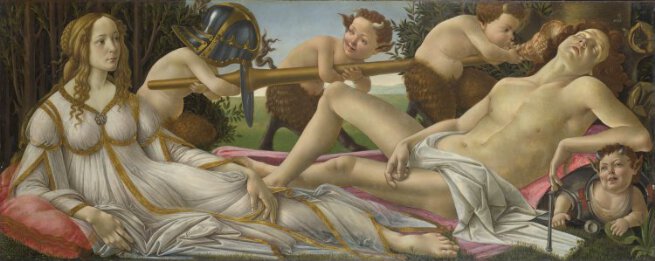
-Sandro Botticelli: Venus and Mars
https://www.nationalgallery.org.uk/paintings/sandro-botticelli-venus-and-mars
Botticelli was a loving man although he remains single for the rest of his life.
Mars, God of War, was one of the lovers of Venus, Goddess of Love. Here Mars is asleep and unarmed, while Venus is awake and alert. The meaning of the picture is that love conquers war, or love conquers all.
He reflects Mars as himself, far apart with his lover. The eyes of Venus shows a sign of loneliness, describing the consequences of falling in a relationship. This painting hung as furniture above the bed.
It showed cupids playing with Alexander's spear and armour. Botticelli's satyrs may refer to this. Mars is sleeping the 'little death' which comes after making love, and not even a trumpet in his ear will wake him. The little satyrs have stolen his lance - a joke to show that he is now disarmed.
2. Rome
-Sandro Botticelli: Venus and Mars
https://www.nationalgallery.org.uk/paintings/sandro-botticelli-venus-and-mars
Botticelli was a loving man although he remains single for the rest of his life.
Mars, God of War, was one of the lovers of Venus, Goddess of Love. Here Mars is asleep and unarmed, while Venus is awake and alert. The meaning of the picture is that love conquers war, or love conquers all.
He reflects Mars as himself, far apart with his lover. The eyes of Venus shows a sign of loneliness, describing the consequences of falling in a relationship. This painting hung as furniture above the bed.
It showed cupids playing with Alexander's spear and armour. Botticelli's satyrs may refer to this. Mars is sleeping the 'little death' which comes after making love, and not even a trumpet in his ear will wake him. The little satyrs have stolen his lance - a joke to show that he is now disarmed.
2. Rome
Artist:
-Raphael: Deliverance of Saint Peter.
https://en.wikipedia.org/wiki/Deliverance_of_Saint_Peter

-Raphael: Deliverance of Saint Peter.
https://en.wikipedia.org/wiki/Deliverance_of_Saint_Peter
The Liberation of Saint Peter is a fresco painting by the Italian High Renaissance artist Raphael[1]. It was painted in 1514 as part of Raphael's commission to decorate with frescoes the rooms that are now known as the Stanze di Raffaello, in the Apostolic Palace in the Vatican. It is located in the Stanza di Eliodoro, which is named after The Expulsion of Heliodorus from the Temple. The painting shows how Saint Peter was liberated from Herod's prison by an angel, as described in Acts 12. It is technically an overdoor.
The fresco shows three scenes in symmetrical balance formed by the feigned architecture and stairs. In the centre the angel wakes Peter, and on the right guides him past the sleeping guards. On the left side one guard has apparently noticed the light generated by the angel and wakes a comrade, pointing up to the miraculously illumined cell. This adds drama to the serene exit of Peter at the right.
3. Mantua (Northern Italy- Capital Province of Mantua)
Where is Mantua?
Mantua was a small, damp, malaria-plagued town, but it occupied a strategic position along the route linking Italy and Germany. From 1327 it was under the control of the landowning Gonzaga family.
-Andrea Mantegna: Painter and Sculptor
His greatest achievements were in the field of fresco painting. Mantegna’s invention of total spatial illusionism by the manipulation of perspective and foreshortening began a tradition of ceiling decoration that was followed for three centuries. Mantegna’s portraits of the Gonzaga family in their palace at Mantua (1474) glorified living subjects by conferring upon them the over-life-size stature, sculptural volume, and studied gravity of movement and gesture normally reserved for saints and heroes of myth and history.
Painting: Oculus in the Camera degli Sposi
He painted the Camera degli Sposi at the celling of Palazzo Ducale at Mantua. Mantegna constructed a system of homogeneous decoration on all four walls of the room, mainly by means of highly realistic painted architectural elements on walls and ceilings, which from ground level convincingly imitate three-dimensionally extended shapes.
Directly above the centre of the room is a painted oculus, or circular opening to the sky, with putti(nude, chubby child figures) and women around a balustrade in dramatically foreshortened perspective. The strong vertical axis created by the oculus locates the spectator at a single point in the centre of the room, the point from which the observer’s space blends with that of the frescoed figures.

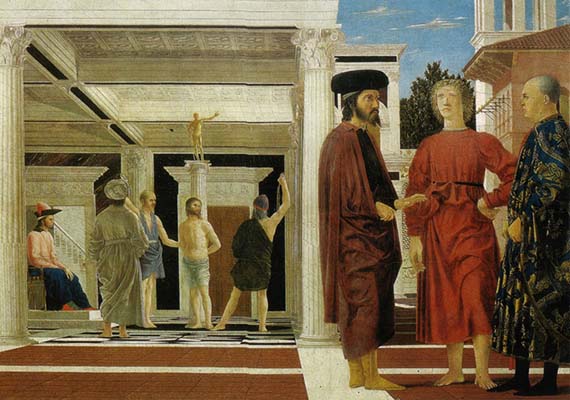
-Piero Della Francesca (Master in perspective): The Flagellation of Christ
Even with the various interpretations that stress political or theological analyses, everyone agrees on Piero's magisterial use of linear perspective to create the mysterious scene. The receding of the floor tiles extends deep into the picture, allowing the spectator to imagine that she could take a few steps forward and enter the scene. Even if the two scenes take place at different historical moments, as suggested by some theories, the two are joined in occupying the interior and exterior of the same space. Piero's rendering of the floor and columns are so accurate that scholars have reconstructed the full space depicted in the painting.
Art historian Frederick Hartt called this painting "the ultimate realization of the ideals of the second Renaissance period," and the impact of Piero's perspectival composition and the cryptic and inscrutable subject can be seen in the 20th-century Surrealist paintings of Giorgio de Chirico.
-Leonardo Da Vinci: Merging science with art
:max_bytes(150000):strip_icc()/136491629-58b59d713df78cdcd874e49b.jpg) Leonardo da Vinci was born in 1452 in Vinci, Tuscany. He was the epitome of the term "Renaissance man" during the High Italian Renaissance. Any subject—and there were many—toward which he directed his insatiable curiosity, artistic talent, and keen scientific mind found itself dissected, improved upon and cataloged for posterity. Leonardo, truly, was a man before his time.
Leonardo da Vinci was born in 1452 in Vinci, Tuscany. He was the epitome of the term "Renaissance man" during the High Italian Renaissance. Any subject—and there were many—toward which he directed his insatiable curiosity, artistic talent, and keen scientific mind found itself dissected, improved upon and cataloged for posterity. Leonardo, truly, was a man before his time."Obstacles cannot crush me. Every obstacle yields to stern resolve. He who is fixed to a star does not change his mind."
—Leonardo da Vinci
Leonardo spent about twenty years in the service of Lodovico Sforza, the Duke of Milan (who frequently neglected to pay Leonardo). His output during this period included two of his best-known paintings: The Madonna of the Rocks (1483-85) and the mural The Last Supper (1495-98).
When Milan was seized by French troops in 1499, Leonardo returned to Florence. It was here that he painted one of the most famous portraits of all time, The Mona Lisa, more correctly known as La Gioconda (1503-06).
Leonardo spent his later years moving between Florence, Rome, and France, working on a variety of projects. He lived long enough to be appreciated and well-paid, a rarity among artists. Throughout it all, he kept prodigious notebooks, in "mirror" writing, to keep track of his ideas, designs, and numerous sketches. Leonardo eventually settled in France, at the invitation of Francis I, an ardent admirer.
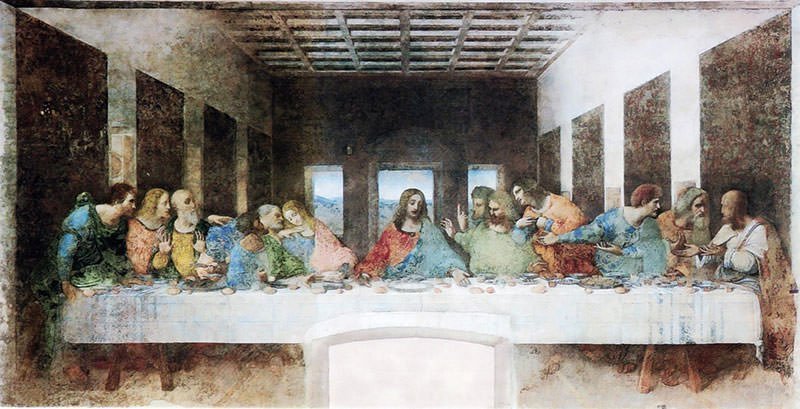 |
| The Last Supper
-Michelangelo Buonarroti: Sistine Chapel
The Sistine Chapel is one of the most famous painted interior spaces in the world, and virtually all of this fame comes from the breathtaking painting of its ceiling from about 1508-1512.
In 1508, Pope Julius II (reigned 1503-1513) hired Michelangelo to paint the ceiling of the chapel, rather than leaving it appear as it had. Before this time, Michelangelo had gained fame through his work as a sculptor, working on such great works as the Pieta and David. He was not, however, highly esteemed for his work with the brush. According to Vasari, the reason why Julius gave such a lofty task to Michelangelo was because of the instigation of two artistic rivals of his, the painter Raphael and the architect Bramante. Vasari says that the two hoped that Michelangelo would fall flat, since he was less accustomed to painting than he was to sculpting, or alternatively he would grow so aggravated with the Julius that he would want to depart from Rome altogether.
Rather than falling on his face, however, Michelangelo rose to the task to create one of the masterpieces of Western art.
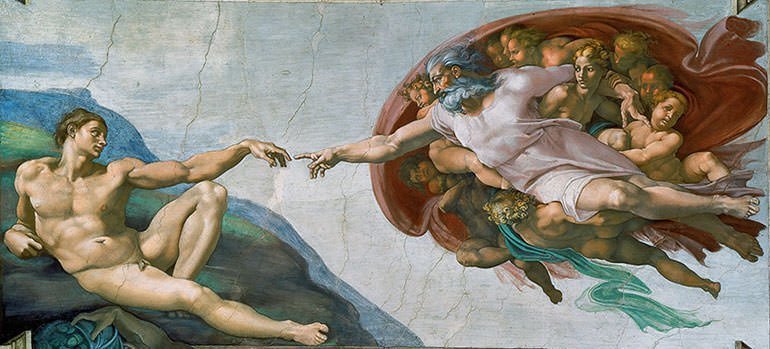
Two of the most important scenes on the ceiling are his frescoes of the Creation of Adam and the Fall of Adam and Eve/Expulsion from the Garden. However, the Creation of Adam will be the focus.
Painting: Creation of Adam
The work done by Michelangelo on the Sistine Chapel ceiling is a cornerstone of Renaissance art and ‘The Creation of Adam’ is the most famous fresco panel of the masterpiece. The popularity of the painting is second only to ‘Mona Lisa’; and along with ‘The Last Supper’, it is the most replicated religious painting of all time. The image of the near-touching hands of God and Adam has become iconic of humanity and has been imitated and parodied innumerable times.
 Northern Renaissance |


Comments
Post a Comment